
6-minute read: Learn how to approve competing holiday leave requests fairly while protecting schedule coverage, critical skills and payroll accuracy.

The holiday staffing problem rarely begins when the schedule shows three uncovered shifts.
It begins weeks earlier, when the first vacation request is approved without a complete view of who else has asked, which roles must remain covered and what the collective agreement or policy requires.
By late September, one employee has emailed a manager about the week between Christmas and New Year’s. Another mentioned it in a text. A third submitted the official form. Each request may seem reasonable on its own. Together, they can leave a department without enough people; or without the particular licences, certifications or supervisory authority it needs to operate.
That is why holiday leave is not only a policy issue. It is a visibility and scheduling issue. A written rule helps people understand how decisions will be made, but managers also need current operational context before they approve anything.
|
KEY TAKEAWAYS
|
The hidden problem is not always the policy
Many organizations already have rules for vacation requests. The policy may define notice periods, peak-season deadlines, maximum absences or a priority method such as first come, first served. In a unionized environment, the collective agreement may establish seniority-based rights or other requirements.
The process still breaks down when requests arrive through several channels or when approved leave is stored separately from the schedule. “First come, first served” is not truly fair if an email, a sticky note and a self-service request receive different timestamps—or if one manager approves quickly while another waits for a monthly staffing meeting.
A useful process creates one doorway for requests, one visible queue and one source of truth for approvals. It also makes the rule governing the decision clear. That gives employees a process they can understand and managers a decision they can explain.
Start with a policy employees ad managers can apply consistently. Review Best Practices for Effective Employee Vacation Policies.
What to decide before peak requests arrive
Peak-period deadlines are only one part of holiday leave planning. Before requests accumulate, HR and operations should agree on seven decision points that create a fair, repeatable process.
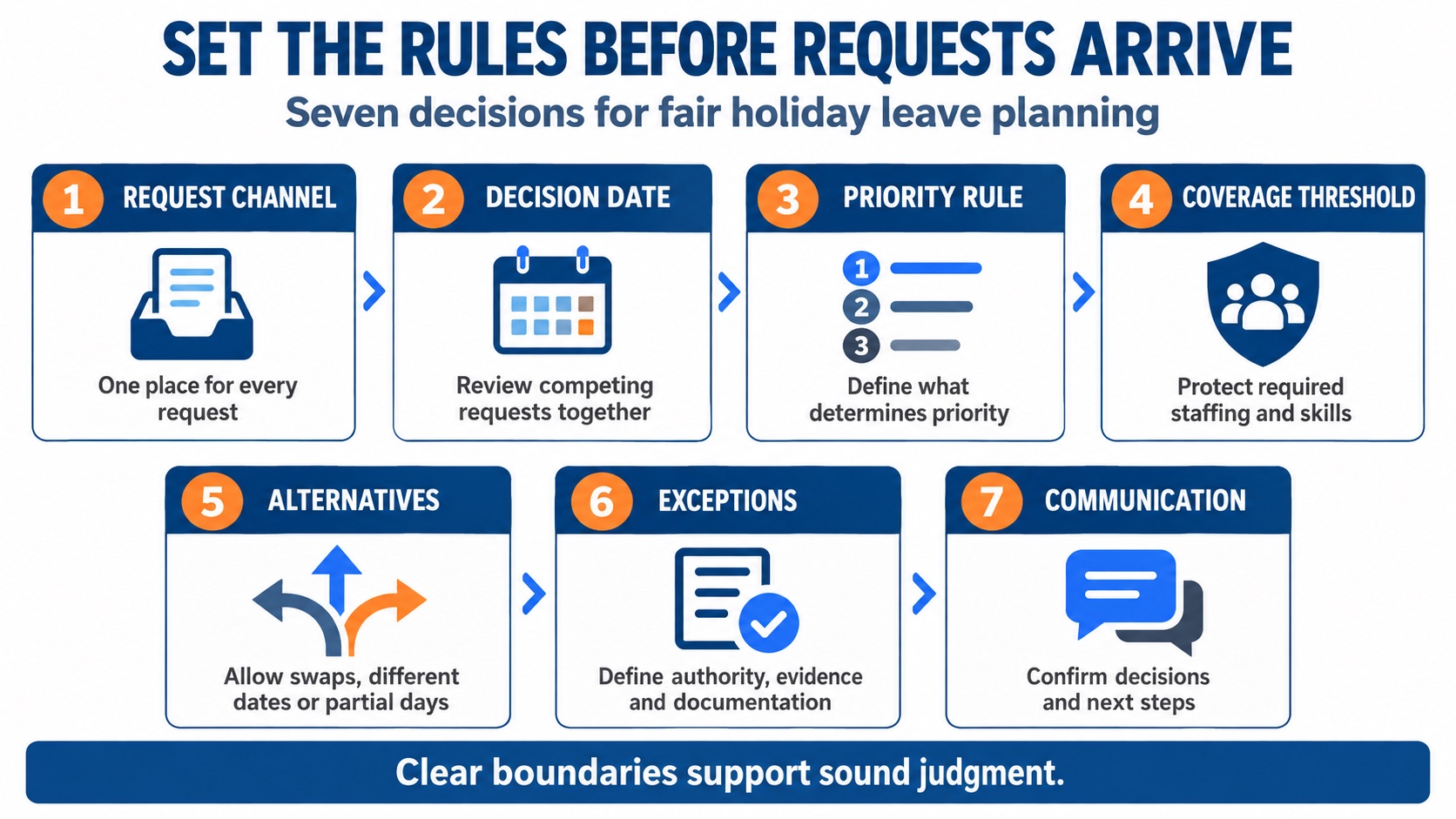
These decisions do not eliminate managerial judgement. They establish clear boundaries so requests can be assessed consistently without losing sight of staffing, skills or service requirements.
What a manager should see before approving
A leave balance only confirms whether time is available. Before approving a request, managers also need the staffing, capability, fairness and cost context surrounding the decision.
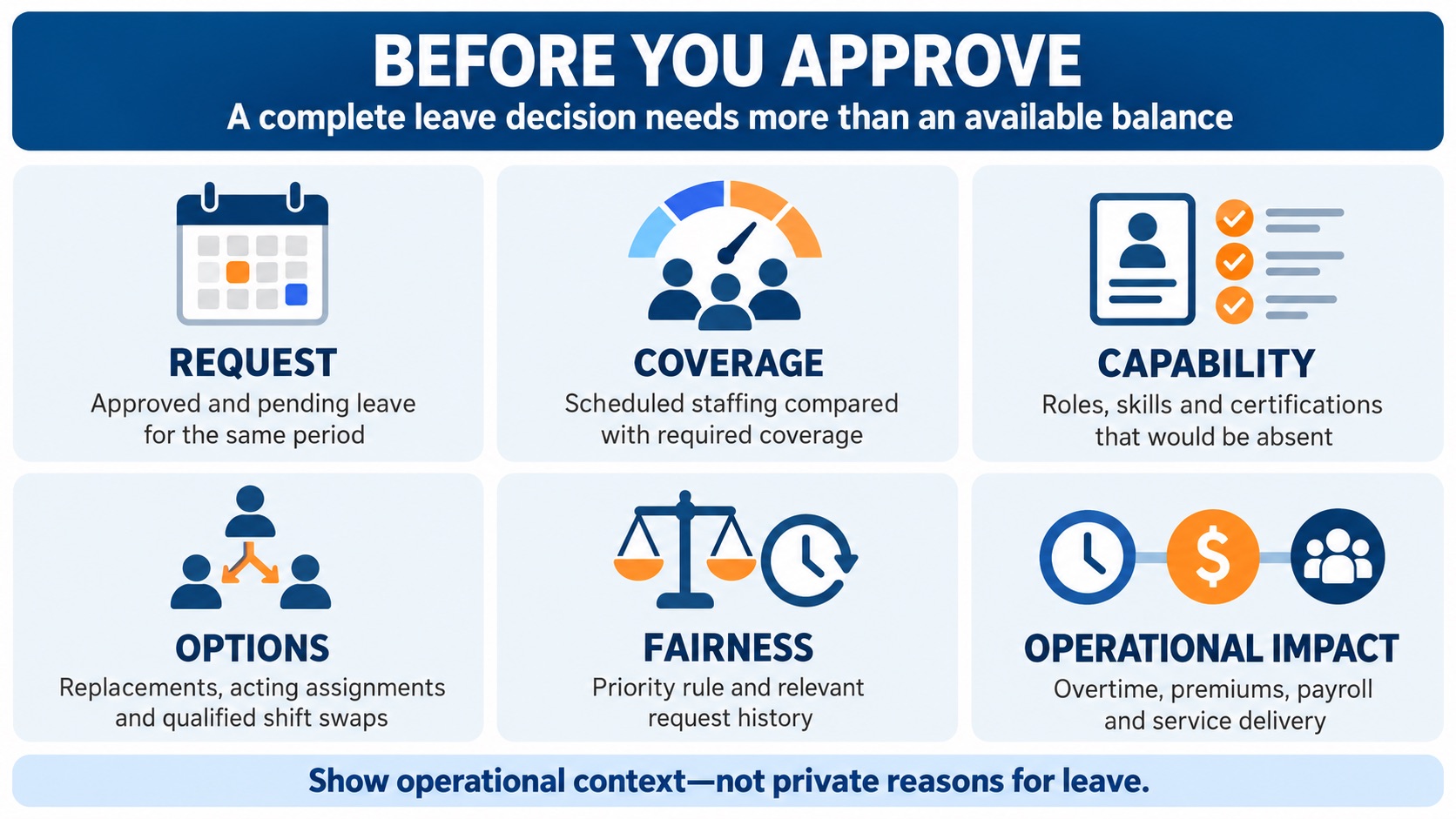
Headcount alone can be misleading. A unit may have enough employees scheduled but still lack the roles, qualifications or authority required to operate safely and maintain service. Managers should see the operational facts needed for the decision, but not private information they are not authorized to access.
Resolve conflicts with a repeatable process
Good workflow design does not automate judgment out of HR. It removes avoidable routing work so the right person can exercise judgment with the right information. It also makes ownership visible. Managers know what is waiting for them, employees can receive clearer status, and HR can see where the process repeatedly slows down.
This distinction matters in governments, healthcare, education, long-term care, and unionized organizations. Authority may depend on reporting structure, classification, competency, bargaining unit, location, dollar limit, or a temporary delegation. A generic inbox cannot represent that complexity reliably.
If leave approvals still depend on forwarding messages and updating separate files, the handoffs deserve attention. See how automated workflows can improve HR and payroll efficiency.
|
HOW STARGARDEN CAN HELP In SG6, employees can submit leave requests through self-service and managers can route them through defined approvals. Once approved, leave is reflected in scheduling and payroll, reducing the need to re-enter the same decision in separate systems. Managers can review requests in the context of workforce information rather than treating each message as an isolated transaction. Connected leave, scheduling, time and payroll records do not decide whose request should win. They make the agreed policy easier to apply, show the operational consequences earlier and preserve the history needed to explain what happened. That is what turns a holiday leave policy into a workable process. Want to see how connected leave, scheduling and payroll could improve peak-period planning in your organization? |
