
6-minute read

Every conversation about long-term care staffing eventually arrives at the same conclusion: there aren't enough people. And that's true. But it's also a convenient way to avoid a harder question: are the systems HR teams are using to manage those people actually fit for purpose?
|
Because here's what gets left out of the shortage narrative: the long-term care staffing crisis isn't just a supply problem. It's also a data problem. A scheduling problem. A compliance tracking problem. And in facility after facility across Canada, the United States, and New Zealand, it's being managed with spreadsheets, paper files, and workarounds that would be considered unacceptable in almost any other regulated industry. |
Fixing that isn't a government problem. It's a systems problem. And it's one that organization that can start solving right now.
|
KEY TAKEAWAYS
|
The demographics aren't waiting for the sector to catch up
The population is aging, and the numbers are unambiguous. In Canada, 1 in 5 Canadians (19%) were aged 65 or older, according to the 2021 Census, the first time in the country's history that seniors outnumbered children aged 0–14. By 2036, that proportion is projected to reach between 23% and 25% of the total population.
The fastest-growing segment is adults aged 85 and older, the group with the highest and most complex care needs. Over 861,000 Canadians were aged 85 or older in 2021, more than double the 2001 figure, and that number continues to climb.
The pattern is consistent across all three markets. In the United States, the population aged 65 and older is expected to nearly double by 2060, placing mounting pressure on a long-term care sector that is already short-staffed. In New Zealand, Health NZ projects a shortage of 12,000 residential aged care beds within eight years, a figure that reflects not just population growth but the direct consequence of nurses leaving the sector faster than they can be replaced.
Every part of the care continuum, from home care and community support through assisted living and facility-based LTC to palliative and hospice care, is built on people. The question isn't whether the sector needs more workers. It's whether the organizations employing those workers are making the job sustainable enough to keep them.
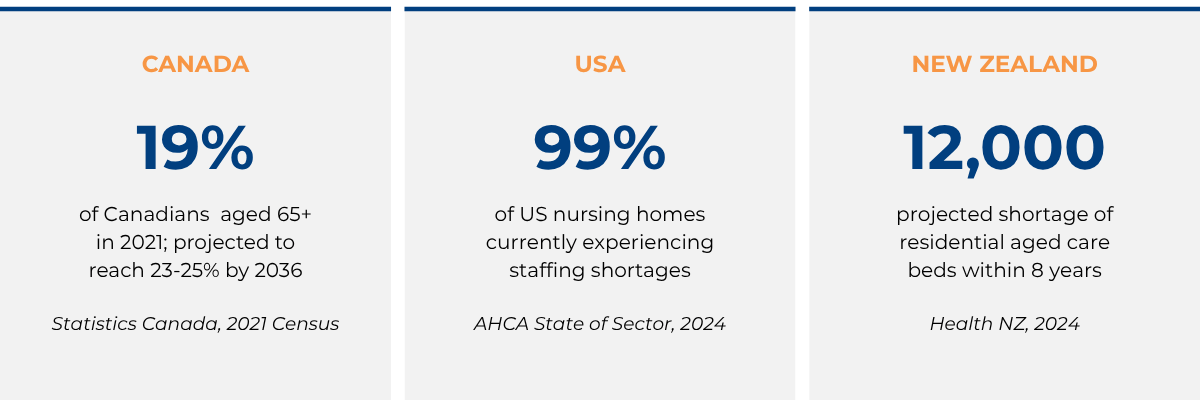
Sources: Statistics Canada, 2021 Census · AHCA State of the Sector, 2024 · Health NZ, 2024
|
FREE RESOURCE Managing complex healthcare workforces starts with getting your Core HR processes right. Download StarGarden's Top 10 Must-Have Workflows eBook to see which processes to prioritize first. 
|
Explore StarGarden's Healthcare HR solutions →
The compliance burden is real, and most people outside the sector have no idea
Governments across Canada, the US, and New Zealand have responded to the care quality crisis by raising the bar — legislating minimum hours of direct care, tightening staffing ratios, and increasing reporting requirements. This is necessary. But it also means the compliance burden on HR teams is intensifying at exactly the moment when the workforce is most stretched.
In Canada, the Health Standards Organization and CSA Group published national standards in January 2023, recommending a minimum of 4.1 hours of direct care per resident per day. These standards are voluntary, not federally legislated, and that gap between what's recommended and what's required is exactly where residents fall through the cracks.
In the United States, the Centers for Medicare and Medicaid Services finalized a federal staffing mandate in 2024 requiring minimum daily nursing aide and registered nurse hours per resident. According to the Kaiser Family Foundation, fewer than half of nursing facilities in 45 states are currently meeting the new requirements.
In New Zealand, staffing pressure has produced a visible consequence: due to the acute shortage of registered nurses in 2023, over 1,000 aged care beds were permanently closed, and a further 1,200 were temporarily closed. Those are real people who needed care and couldn't access it.
Because HR in a long-term care environment isn't just processing payroll and running onboarding. They're managing all of this simultaneously:
- Continuous recruitment cycles driven by turnover that outpaces hiring in many facilities
- Credential verification and tracking across a workforce with diverse certifications and license renewal requirements regulated by different bodies in each province, state, and jurisdiction
- Scheduling complexity involving union rules, overtime limits, and regulatory minimums at the same time
- Health and safety incident tracking for a workforce with one of the highest physical injury rates of any sector
- Compliance reporting that requires accurate, complete records, not estimates stitched together from three different spreadsheets at month-end
If any of those pieces break down, the consequences aren't abstract. Residents get less care. Staff burn out faster. The facility's regulatory exposure grows.
The pipeline isn't just thin. It's leaking.
The scale of the shortage is significant and consistent across all three markets.
In the United States, a 2024 survey by the American Health Care Association found that 99% of nursing homes are currently experiencing staffing shortages, with two-thirds concerned that ongoing workforce challenges may force them to close. Nearly half have already had to limit new admissions.
In New Zealand, the Aged Care Association has reported a shortage of approximately 1,000 registered nurses, with demand for residential aged care forecast to require an additional 15,000 beds by 2030.
In Canada, approximately 350,000 PSWs are currently employed across all sectors, and the pipeline is leaking badly.
Here's the number that cuts to the heart of it: approximately 40% of PSW graduates leave their long-term care jobs within a year of graduating.
Four in ten people entering this workforce are gone within twelve months of starting. No recruitment campaign, no credential incentive, no government-funded training program fixes a leaking bucket. Retention is the problem, and retention is driven by working conditions. Working conditions in LTC are directly shaped by whether the systems supporting frontline staff actually function.
The workers who stay in LTC do so because they're committed to the people in their care. The ones who leave aren't weak or uncommitted. They're burning out under scheduling chaos, administrative burden, and the particular exhaustion that comes from feeling unsupported by the systems around them. That dynamic plays out in different forms across jurisdictions, but the underlying cause remains consistent.
HR is being set up to fail
Most industries spent the last decade investing in integrated platforms that connect scheduling, time and attendance, payroll, credentialling, and HR records into a single source of truth. Long-term care has lagged - for reasons that are understandable in isolation (tight budgets, operational focus, legacy systems) but are no longer defensible as a collective position.
The result is HR teams who are technically accountable for regulatory compliance but working with fragmented data that makes compliance nearly impossible to guarantee. A credential expiry is living in someone's inbox. A scheduling decision is made without visibility into overtime exposure. Payroll is processed from timesheets that don't automatically flag rule violations.
"This isn't a criticism of the HR professionals doing this work; it's a criticism of expecting good outcomes from broken processes."
You cannot maintain a quality care environment without accurate, accessible workforce data. That's not an opinion. It's a statement about how compliance, safety, and operational continuity actually work. The facilities that struggle most with staffing aren't always the ones in the hardest labour markets; they're often the ones whose internal systems create friction at every step.
What good actually looks like and why most facilities aren't there yet
Facilities that manage staffing complexity most effectively share a few things in common. None of it is sophisticated technology for its own sake. It's the basics, done properly and connected.
Credential tracking is automated and alerts fire before the gap, not after. In a regulated care environment, a lapsed certification isn't just an administrative inconvenience. It's a liability event, a potential resident safety issue, and, in some provinces, a reportable compliance breach. Manual spreadsheet tracking isn't a system; it's a risk waiting to happen.
Scheduling is integrated with payroll. In LTC, scheduling changes happen constantly: callouts, shift swaps, overtime needs, and agency staff. When changes require manual re-entry into a separate payroll system, errors pile up. Double-entry leads to discrepancies and unreliable hours-of-care reporting.
Shift supervisors have real-time visibility without having to call HR. A supervisor shouldn't need to call someone to check whether they're compliant with direct care hour requirements mid-shift. That information should be current, easy to access, and not rely on a spreadsheet last updated on Tuesday.
Incident reporting always follows a documented workflow. Health and safety incidents in LTC are not rare. How they are documented, reported, and followed up on has real consequences; for the employee, the resident, and the facility's regulatory liability. An ad hoc process produces ad hoc records. That’s not good enough for regulators.
|
FREE RESOURCE Offboarding is one of the highest-risk moments for access management and compliance in any regulated environment. Download StarGarden's Employee Termination eBook for guidance on handling it compliantly and defensibly. 
|
The argument needs to be made
There's a reflex in this sector to frame every workforce challenge as a funding problem that governments need to solve. And funding absolutely matters. But there are things organizations can control right now, and the quality of their HR systems and processes is one of them.
The staffing crisis won't be solved by recruitment campaigns alone. It will be solved, in part, by making the jobs of the people already in these facilities sustainable enough that they stay. That means less administrative chaos, better support during incidents, and schedules that actually respect the collective agreements and regulations they're bound by.
That's an HR and systems problem as much as it's a labour supply problem. And it's one that's solvable not by the next government or the next funding cycle, but by decisions that HR and operations leaders can make today.
The pressure on long-term care organizations across Canada, the US, and New Zealand is here, it's intensifying, and it is not going to ease. The question is whether the systems supporting the people doing this work will catch up, or whether HR teams will keep being asked to deliver quality outcomes from broken infrastructure.
They deserve better than that. So do the residents depending on them.
Read how HR analytics is transforming workforce management on the StarGarden blog →
|
HOW STARGARDEN CAN HELP StarGarden's HCM platform includes dedicated features for healthcare and long-term care. It offers automated credential tracking with expiry alerts, complex scheduling for unionized workforces, integrated payroll, and health and safety incident management with full audit trails. Every workflow is documented, timestamped, and built for regulatory scrutiny. StarGarden has over 40 years of experience serving governments, healthcare, education, and unionized industries in Canada, the USA, and New Zealand. StarGarden understands the compliance demands and complex labour relations that define this sector. 
|