
4-minute read: Learn how authority-based routing, delegation, and escalation keep HR approvals moving when the usual approver is unavailable.

The most important approval in an HR process should not be trapped in someone’s inbox.
Yet that is exactly how many supposedly automated processes behave. A leave request, time correction, training approval, employee transfer, or pay change enters a system, reaches one named approver, and waits. If that person is on vacation, covering another role, or no longer responsible for the decision, the workflow stops being automated. HR becomes the routing engine.
The visible symptom is a late approval. The underlying problem is that the process was designed around a person instead of the organization’s authority structure.
|
KEY TAKEAWAYS
|
A digital form is not the same as a resilient workflow
Moving a paper form online solves only the first step. It may improve legibility and make submission easier, but it does not answer the harder operational questions: Who is authorized to decide? What happens when that person is unavailable? Which conditions require another review? When should a stalled request escalate? What information must remain attached to the decision?
If employees submit a digital request but HR still checks an organization chart, forwards email, reminds managers, and reconstructs the history later, the organization has digitized the form without redesigning the process.
If your workflows still rely on email chains and manual follow-up, explore how StarGarden routes HR work through defined authority, rules, and approval.
Five tests for an HR workflow that keeps moving
A resilient workflow should pass five practical tests. Together, they show whether the process can reach the right decision-maker, continue through absences or delays, and preserve enough context and history for the organization to remain accountable.
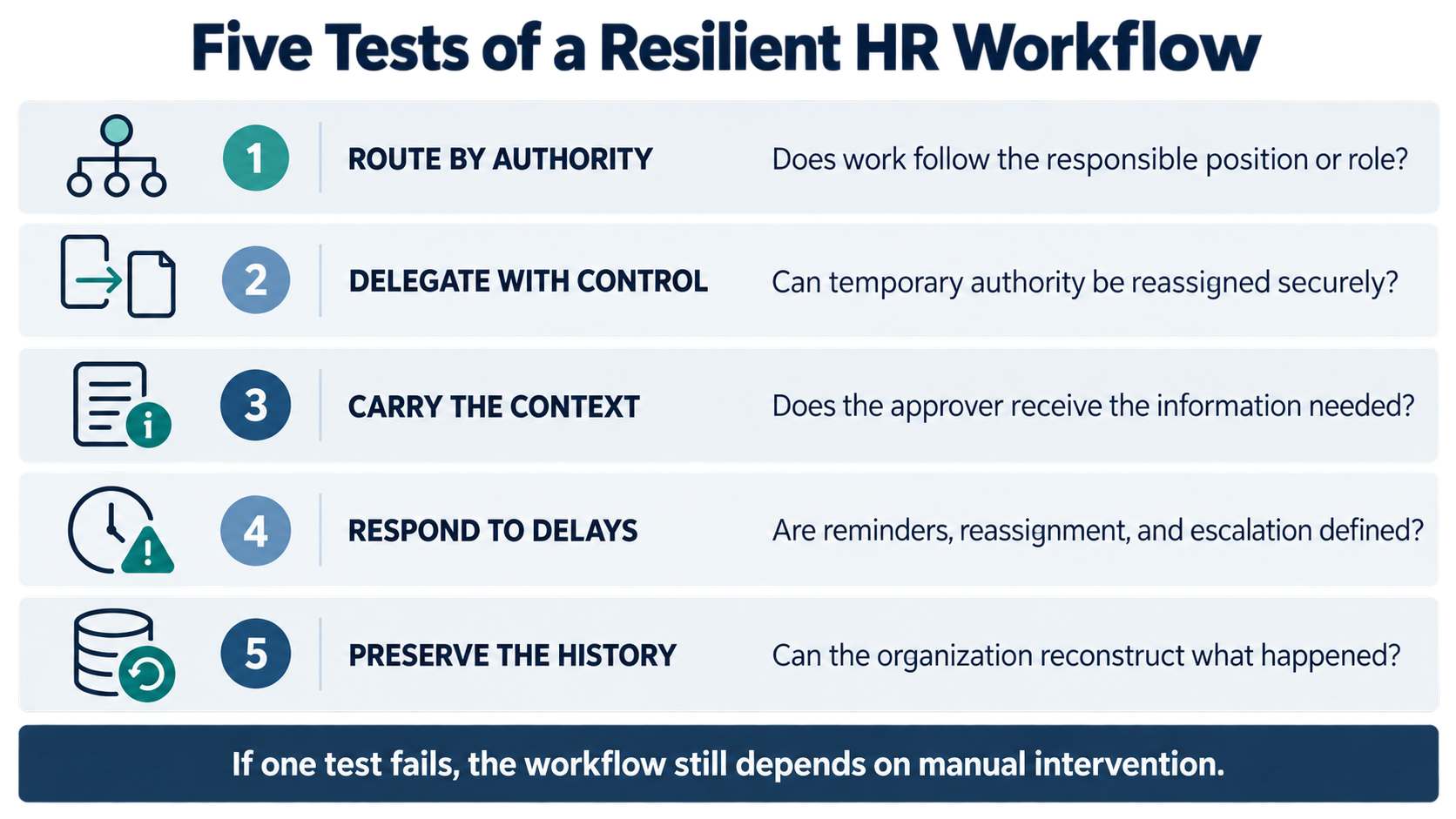
A failed test points to a specific design weakness. Routing tied to a name becomes outdated when responsibilities change. Informal delegation can weaken access control. Missing context forces approvers to search other systems, while undefined escalation leaves stalled work for HR to discover. If the record cannot reconstruct the request, routing path, actions, timestamps, and outcome, routine questions can become difficult to answer and challenged decisions harder to review.
Named routing still has a place, but it should be a deliberate exception. The stronger foundation is current authority: the position, reporting relationship, role, competency, or threshold that governs the decision, supported by time-limited delegation and a clear response when work stops moving.
Need more than a basic approval chain? See how StarGarden supports configurable business processes, authority rules, escalation, and recorded task history.
What to map before automating an HR process
A workflow tool cannot repair an undefined process on its own. Before anyone configures forms, routing, reminders, or approvals, HR and the operational owner need a shared picture of how the process should work. The eight questions below provide a practical agenda for that conversation.
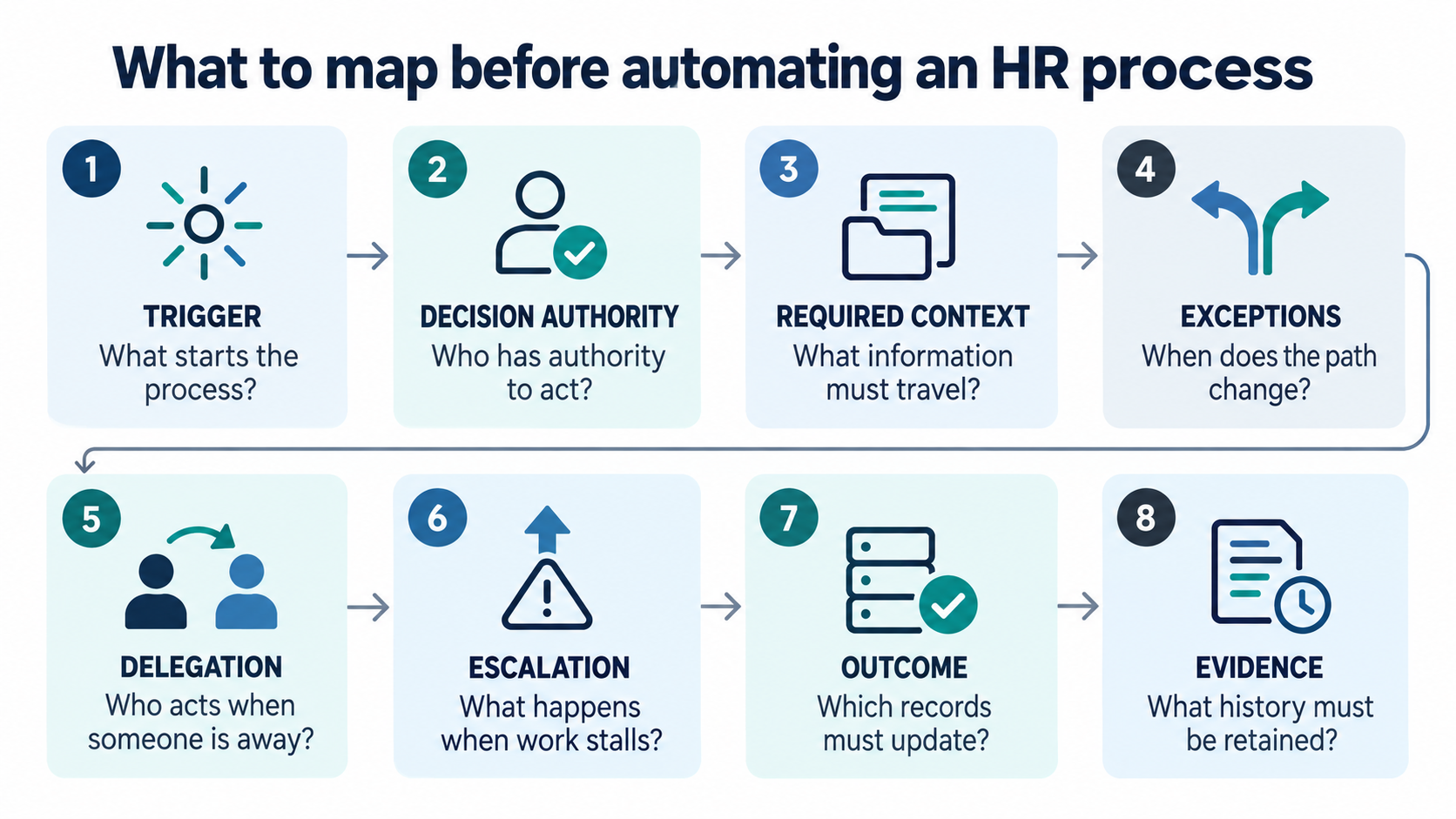
Start by answering each question in plain language, using a real request as the test case. If the team cannot agree on who has authority, which exceptions change the path, what happens when work stalls, or which records must update, the process is not ready to automate. Resolving those decisions first prevents the software from simply making an unclear process move faster.
Automation should reduce chasing, not accountability
Good workflow design does not automate judgment out of HR. It removes avoidable routing work so the right person can exercise judgment with the right information. It also makes ownership visible. Managers know what is waiting for them, employees can receive clearer status, and HR can see where the process repeatedly slows down.
This distinction matters in governments, healthcare, education, long-term care, and unionized organizations. Authority may depend on reporting structure, classification, competency, bargaining unit, location, dollar limit, or a temporary delegation. A generic inbox cannot represent that complexity reliably.
|
HOW STARGARDEN CAN HELP StarGarden Workflow is embedded in a broader HCM environment that connects HR, payroll, time, scheduling, recruiting, training, performance, and employee changes. Work can be routed using configured forms, rules, positions, roles, competencies, users, and delegated authority, with escalation and history carried through the process. That position-based foundation is especially useful when organizational structures and responsibilities change. The workflow can reflect who currently has authority to act rather than depending on a static name or an inbox someone must remember to monitor. Ready to make approval resilient to vacations, vacancies, and changing responsibilities? Explore StarGarden HCM and workflow automation for complex organizations. |
